
Switching to the Satoshi standard and Lightning Network connectivity makes Bitcoin more tangible and easy to use. AAX has made the first move in the crypto space, already providing BTC to SAT
Switching to the Satoshi standard and Lightning Network connectivity makes Bitcoin more tangible and easy to use. AAX has made the first move in the crypto space, already providing BTC to SAT
The Monetary Authority of Singapore (MAS) and Elevandi (a not-for-profit entity set up by the MAS to connect people and businesses, ideas and insights in the FinTech sector in Singapore and globally) today announced the return of the Singapore FinTech
The Future Blockchain Summit, the MENA region’s longest running exhibition and conference connecting key stakeholders across Blockchain, crypto, and Web 3.0 will return to
Doconomy, a Swedish world-leading impact tech provider for banks, SMEs, and corporates, joined forces with Salt Edge, a leader in offering open banking solutions,
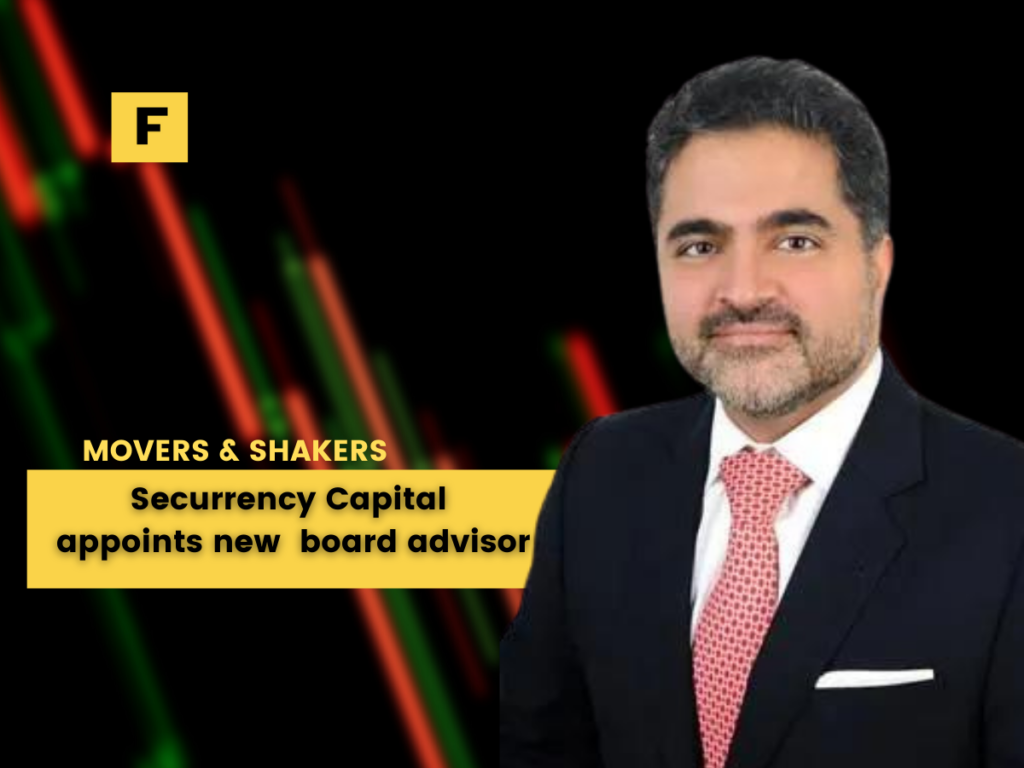
ADGM-based Securrency Capital announced that Dr Ryan Lemand has joined as a board advisor to the institutional DeFi (or “decentralized finance”) brokerage. Dr Lemand brings decades of financial services experience and a proven track record of leading innovative and diverse investment teams around the world.
Dr Lemand will share his extensive knowledge and unique experience in financial services to advise the board of directors in setting the strategic direction for Securrency Capital. Securrency Capital is a blockchain-enabled brokerage focused on being a regional and international leader in providing access to trading in traditional and digital assets.
“I’ve long agreed with Securrency Capital and its leaders that Blockchain technology has the potential to improve lives and build a more trustworthy and secure financial system,” Dr Lemand stated. “It’s an honour to join Securrency Capital as board advisor and to be a part of a values-driven firm that is constantly innovating to enable and enhance the way we invest.”
“Dr Lemand has long been a visionary leader in the financial services, asset management, and brokerage industries, applying his extraordinary insight, experience, and passion for capital markets to the cause of improving lives and fostering a more secure financial system,” added Amir Tabch, Chairman and Senior Executive Officer of Securrency Capital. “We’re delighted to welcome him as a board advisor to Securrency Capital, and I’m confident that we will all benefit from his leadership and knowledge.”
Dr Lemand is the former senior executive officer and board director of ADS Investment Solutions (ADSI), the ADS Securities group’s wealth and asset management company, which he founded on behalf of the group and grew to become one of the largest companies in Abu Dhabi Global Market (ADGM).
Until 2015, Dr Lemand was the senior advisor and head of risk management at the UAE Securities & Commodities Authority, the UAE’s federal securities regulator. In this capacity, Dr Ryan led and contributed to initiatives which gave way to the development of several fundamental financial regulations in the UAE including the collective investment scheme regulations as well as regulations on financial analysis and consultancy services, market making and others. He was principally responsible for leading the funds and investment management team that handled the licensing and approvals for local and foreign mutual funds and investment managers. Additionally, he helped develop a risk management framework for UAE licensed brokers.
Prior to that, Dr Lemand served as the lead portfolio manager at Fortis Investments in Europe, where he was responsible for managing a 14.6-billion-euro portfolio of assets, namely in the space of credit derivatives.
Dr Lemand is a sought-after speaker and contributor to major financial market discussions and events in the UAE and the wider MENA region.
Dr Lemand holds a PhD (summa cum laude) in Financial Econometrics from the École Normale Supérieure, France, and is the author of two books on financial contagion, as well as several research articles on financial correlation. Dr Lemand also taught financial econometrics courses at Paris II-Assas University and Paris IX-Dauphine University in Paris, France.
Securrency Capital Limited is a blockchain-enabled brokerage. It is registered in Abu Dhabi Global Market (ADGM) and has received an in-principal approval from ADGM’s Financial Services Regulatory Authority as a prudential category 3A broker and is in the process of obtaining its financial services permission. Securrency Capital deploys Securrency’s proprietary asset tokenization technology, which automates multi-jurisdictional compliance and financial services and enables the movement of regulated value at the speed of tomorrow.
sync. – the smart open banking app, partnered with Salt Edge, the leader in providing open banking solutions, to significantly boost its open banking offer and enable users to link their bank accounts from a wide number of new countries, including Australia, South Africa, and Hong Kong.
With open banking gaining more and more popularity, consumers are getting the taste of better control of personal finances and associated personal data. Recent surveys show that pandemic has shifted the way people approach data privacy and control, which is enforced by the expansion of the services underpinned by APIs. Consumers are not asking for open banking specifically. They are asking for control, safety, and convenience, which is exactly what sync. app has been offering ever since its launch back in 2020.
sync. uses open banking channels and allows consumers to connect their existing bank accounts and credit cards alongside their sync. current account directly in the app, making it easier to effectively manage money and budget. Throughout its development, the company behind the app found it critical to offer as wide a coverage of open banking-based services as possible, beyond Europe. And since Salt Edge has the fastest-growing and broad global connectivity, sync.’s choice was obvious, and achieving its goals meant leveraging Salt Edge’s global data aggregation solution.
Partnering with Salt Edge helps us achieve our vision of leading the way in open banking and providing real benefits to our users. We were obviously aware of SaltEdge as one of the leading open banking aggregators in the world and it was clear that the breadth of connections they had developed meant they were a clear market leader.
Ricky Lee, CEO and Co-Founder of sync.
Salt Edge’s award-winning global bank connectivity with up to 5,000 banks from more than 50 countries worldwide is contributing to sync. offering its users the chance to fully control their finances, manage and track their money, tailoring its solutions with customised insights.
End-users may not really care about the name of the technology backing-up the services they’re using. What they do care about is the safety of their data, the commodity of having it all aggregated in one single app, and the coverage they get, by connecting as many banks as possible, from as many locations as possible. We are thrilled to be able to work with sync.money on achieving that and ensuring that their users get truly the best out of open banking while staying secure.
Cristian Gheorghita, Open Banking Expert at Salt Edge

Next-generation payment processing company, Radar Payments by BPC, has been selected to tackle eCommerce fraud prevention by Singapore’s largest home-grown online payment solutions fintech Red Dot Payment (RDP), an e-commerce enabler focused primarily on serving the e-commerce and hospitality verticals.
RDP has selected the Fraud Risk Management and Prevention solutions delivered as a SaaS model from Radar Payments after reviewing other fraud detection systems. Their choice was influenced by its peerless technological capabilities and ease of integration, as well as its affordability and excellence in account management.
Established in 2011, RDP was founded by Randy Tan, who is still leading the company as its CEO. Initially starting in Singapore, RDP has expanded to other regions, with local offices in Australia, Indonesia, Taiwan and Thailand, and further expansion provisionally planned in Japan, Hong Kong, and Malaysia. In July 2019, the fintech and e-payment business PayU took a majority stake.
RDP was ranked #35 out of 500 companies in the Financial Times’ special report on high-growth companies in the Asia Pacific after demonstrating phenomenal revenue growth of 171% CAGR. They were also ranked Top 10 Fastest-growing firms in Singapore by the Strait Times in 2020.
Earlier this year, RDP became a principal member with both Visa and MasterCard. They are already an acquirer for AliPay, Diners Club International, WeChat Pay, and UnionPay, with a payment suite that includes AMEX, PayPal, PayLah and PayNow (SGQR) and many other alternative local payment methods in the respective countries they operate in.
RDP selection of Radar’s Payments Fraud Risk Management and Prevention service comes at a time when the number of online cybercrime rises due to digitisation around the world. The technology developed by Radar Payments was not only singled out for its best in class performance but also its proven track record in helping financial institutions and businesses of all sizes to tackle vulnerabilities within the digital ecosystem for consumers across regions.
David Owyong, COO, Red Dot Payment, commented: “We believe that conquering eCommerce fraud requires a global perspective, and we pride ourselves on working closely with our merchants to help them harness the power of payments. As we overcome the turbulence of the past 24 months, we believe that the hospitality sector is the next industry where we’ll witness huge advances in eCommerce. With the help of Radar Payments, we’ll continue to support local merchants in this field as well as create a secure environment for international companies with ambitions to serve consumers in Southeast Asia.”
Terry Paleologos, COO at BPC said: “We are thrilled to be helping one of Singapore’s fastest-growing companies to grow even faster, through ensuring that they have best-in-class fraud prevention service which comes with unparalleled expertise and local insights that do help remove any friction to the customer payment experience.”

Social investment platform, eToro, has just announced the addition of two assets to its crypto offering: The Sandbox and Celo. This brings eToro’s offering to 42 crypto assets.
“We’re seeing huge demand for DeFi and metaverse tokens, and we’re delighted to be able to offer more of these assets to our customers,” said Doron Rosenblum, vice president of business solutions at eToro. “The addition of these new tokens to the platform demonstrates the breadth of choice available to investors in the cryptoasset market today. We will continue to grow our crypto offering to enable users to diversify their portfolios with a broad range of cryptoassets.”
The Sandbox is a virtual game that combines blockchain technology, decentralised finance (DeFi), and non-fungible tokens (NFTs) in a 3-D metaverse. With design tools, it allows players to create and customise their games and digital assets. The virtual goods created can then be monetised as NFTs and sold for SAND tokens – the native token of The Sandbox.
Celo, meanwhile, is a DeFi platform that makes it easier for cryptoasset users and investors to settle transactions via their mobile phones. Investors in the token can vote on initiatives, such as making the CELO blockchain carbon neutral.
For now, the SAND and CELO tokens are not available to US users.
This news rounds off a busy year for eToro, which in the last quarter alone launched the eToro Money program for UK users, opened a DeFi portfolio, and appointed of Lule Demmissie to the role of US CEO.

The MENA FinTech Association (MFTA) Open Banking Working Group, in collaboration with the Arab Regional FinTech Working Group, has today published a landmark report Open finance: A framework for the Arab region is more than a question of scope.
This report on open finance is a product of collaboration between the Open Banking Working Group of the MENA FinTech Association and the Arab Regional Fintech Working Group.
The report explains why open finance is a step change for the finance sector, and why it offers unique opportunities for the Arab region but also brings challenges for both regulators and firms alike.
The report foresees the need for a change in the way firms think about and use data and it argues that open finance may require cultural shifts around the globe. That is because open finance, the report says, is not just about a bigger or broader version of open banking. It is a fundamentally new development.
Nameer Khan, Chairman & Founding Board Member, MFTA said:
“Unlike open banking, open finance brings together a host of participants across financial services. Any hierarchical notion of data providers and third-party recipients is long gone. In its place is a level playing field where all parties may share or receive data as part of a collaborative ecosystem.”
Hakan Eroglu, MFTA Open Banking Working Group Lead, and Global Open Banking Lead, Advisors at Mastercard, said:
“Yet open finance is more than open banking with a broader scope. Where an open banking framework is designed to spur the innovation of products and services, open finance takes those products and services and then connects them across a shared framework as well. The result is a consistent and richer customer experience regardless of the businesses involved.”
Kareem Refaay, Managing Director, The London Institute of Banking & Finance MENA, said:
“As part of our mission to contribute to the region, we are proud to support MFTA in developing and publishing the new Open Finance Report. Along with contributions from stakeholders, the report will ensure access to regional insights and knowledge sharing across open finance.”
Open finance: A framework for the Arab region is more than a question of scope was presented at the annual Fintech Abu Dhabi 2021 festival (22nd – 24th November 2021), and launched on 6th December 2021. It follows the publication last year of MFTA OBWG’s first report Open banking: A vision from the Arab world.
Open finance: A framework for the Arab region is more than a question of scope includes the insights of many regional and international experts:
Download a copy of Open finance: A framework for the Arab region is more than a question of scope
Australian bank Westpac has agreed terms to buy money management app MoneyBrilliant. Financial details were not disclosed.MoneyBrilliant is a budgeting and cashflow tool that helps users manage their money by providing practical insights and displaying their financial accounts in the one place.
The firm’s technology will ultimately be integrated into Westpac’s own app.
Chris de Bruin, chief executive, consumer and business banking, Westpac, says: The acquisition of MoneyBrilliant is another important step in Westpac’s digital strategy. In recent years we’ve seen demand grow for simple and practical digital tools to help customers manage their personal finances.
“We look forward to further building on MoneyBrilliant’s existing capabilities and making these available to our customers.”
The bank is buying the app from AMP Limited and management shareholders, with the deal slated to be closed next month.

H.M. Government of Gibraltar has announced that it will begin a process by which it will integrate blockchain technology into its legacy systems in order to streamline government processes. It is envisioned that the implementation, which will initially be rolled out on a pilot basis, will improve the delivery of public services to individuals and organisations residing or operating in Gibraltar.
The proposed blockchain solution will build upon and enhance the functionality of Gibraltar’s eGov system, with the focus of the initial phase being to enable users to store government-issued and certified credentials. The pilot integration project will be delivered by HM Government of Gibraltar who has been working closely in partnership with two firms.
Bitso, a Gibraltar licensed cryptocurrency platform, and IOVlabs, the team behind the RSK blockchain. Both firms have long supported and deeply contributed to Gibraltar’s work in the DLT sector. The government has developed a close working relationship with these firms over time and values their counsel.
Gibraltar’s Minister for Digital and Financial Services, the Hon Albert Isola MP, said, “Gibraltar has successfully positioned itself as a forward-thinking jurisdiction for innovative businesses developing and offering blockchain-related solutions. The implementation of blockchain technology into our processes in partnership with our stakeholders working here will further improve the way in which our community interacts with the government.
We have already begun the process of digitising many of our services through the introduction of the eGov system earlier this year. I am confident that the RSK Blockchain will serve as a solid foundation on which to build the intended programme of services in a coordinated and phased manner further complimenting the work already undertaken.
I am pleased to recognise the invaluable support and contribution provided by our good friend Diego Gutiérrez Zaldívar, CEO of IOVlabs, and his team, who will provide technical and other support on the initiative working hand in hand with our Digital Services team. This project would not have been possible without their total support for which we are most grateful.”
Minister Isola continued, “Equally, the fantastic contribution by Bitso is most welcome as their very generous donation to HM Government of Gibraltar has allowed this exciting project to become a reality and will enable this work to commence in early 2022. At this moment in time, Government would not otherwise commit funding to this project.
The support and commitment of Bitso to the development of Gibraltar as a centre for innovation is most appreciated and we are thrilled to continue to strengthen our relationship with them.”

Shinhan Bank the leading bank in South Korea, announced that it has completed the development of a proof-of-concept, with a global megabank outside of Korea, built on the Hedera network, leveraging stablecoins and focused on international remittances. Utilizing the Hedera Token Service (HTS) and Hedera Consensus Service (HCS), the project aims to test the issuance and distribution of stablecoins, applied to a financial use case that typically suffers from high fees, longer waits and absence of tracking feature.
Under current financial systems, when individuals or organizations send cross-border transfers, the customer bears high intermediary bank costs. For cross-border transfers between countries that lack liquidity and a direct network, customers typically pay the equivalent of an extra twenty to eighty US dollars for intermediaries’ fees on top of regular cross-border transfer fees. Transactions typically take three to seven days to be completed. Furthermore, the customer has no visibility during the transaction, and cannot track his or her transfer during the process. With the stablecoin solution developed by the banks, individuals and organizations can send and receive funds in a locally denominated stablecoin, with remarkably low fees.
Shinhan plans to mint South Korean Won (KRW)- backed stablecoins and the partnering bank will mint stablecoins backed by their local currency. Users will be able to buy KRW-based stablecoin that Shinhan issues, and send them to an account at the partner bank. The recipient will then be able to receive the funds in a locally denominated stablecoin and exchange it for the local currency. The two banks will use the Hedera Consensus Service (HCS) both to track and record transactions and confirm the foreign exchange rate at the time of each transaction.
“International remittances were a massive market of $702 billion in 2020, with $539 billion going to low- and middle-income countries,” said Mance Harmon, CEO and Co-founder of Hedera. There is a massive opportunity to cut out the middleman and make this process dramatically more efficient and cost-effective, getting the most money possible to people who often need it urgently. We commend Shinhan and their partner for developing this solution, and are proud that it takes advantage of the economic and speed benefits that only Hedera can provide.”
Shinhan Bank is a leader in leveraging distributed ledger technology (DLT) to drive financial innovation. In January of this year, Shinhan invested in Korea Digital Asset Custody (KDAC), an industry consortium of businesses that provide digital-asset custody services. In March, Shinhan completed a demonstration platform for central bank digital currencies (CBDCs), together with LG CNS. The company joined the Hedera Governing Council in April 2021.
Officials at Shinhan Bank said, “Joining the Hedera Governing Council this spring has allowed us to significantly accelerate our engagement with other global industry leaders to leverage the power of Hedera’s fast, fair, green public distributed ledger. Cost-effective, efficient international remittance is the perfect, real-world financial use case to build on a network that provides Hedera’s speed and low cost. We are excited to work with a leading global banking partner to deliver the first of what we hope will be many solutions that drive the next generation of finance and financial inclusion.”
U.S. banking regulators intend to clarify in 2022 what role traditional banks can legally play in the cryptocurrency market, they said on Tuesday.
In a statement, regulators said they plan to make clear what sort of activities banks can engage in involving cryptocurrency, including holding it on their balance sheets, issuing stablecoins and holding crypto assets and facilitating crypto trading on behalf of customers, among other currently murky areas.
The joint statement from the Federal Reserve, Federal Deposit Insurance Corporation and Office of the Comptroller of the Currency is an update on work done by an interagency “sprint” team convened earlier this year.
While not providing details, the agencies said the rapid growth of cryptocurrency presents “potential opportunities and risks” for traditional banks. They said regulators want to provide “coordinated and timely” clarity to the institutions they monitor.
“The agencies have identified a number of areas where additional public clarity is warranted,” the agencies said. “Throughout 2022, the agencies plan to provide greater clarity on whether certain activities related to crypto-assets conducted by banking organizations are legally permissible, and expectations for safety and soundness, consumer protection, and compliance with existing laws and regulations.”
Agency officials have been working on identifying risks facing banks engaging in crypto activity, as well as whether existing regulations must be updated to account for that activity.

Deutsche Bank has rolled out Swift’s new Beneficiary Account Validation (BAV) service, enabling clients to verify payee account details before an international payment instruction is sent.The service enables Deutsche to ensure that payments from its clients are arriving at the intended beneficiary using the correct account details, by validating the information centrally via Swift. The bank can also use it to respond to incoming validation requests.
More than 70 banks have so far signed up to the BAV service but Deutsche Bank is the first to roll out the system on a global basis, building a straightforward API layer on top, enabling it to validate accounts across its global markets in real time.
The German lender also plans to incorporate BAV into its online cash management channel in the next year, where clients could pre-validate their beneficiary accounts while the payments are being created online.
Jose-M Buey, global head, core platforms and accounts solutions, Deutsche Bank Corporate Bank, says: “The BAV service not only addresses a key market problem prevalent today, but also brings significant operational benefits in terms of end-to-end efficiency and fraud reduction to our corporate clients.
“It is also a clear example of how API technology can be used to create an innovative solution that perfectly aligns with our strategy to build a real-time API based accounts platform.”